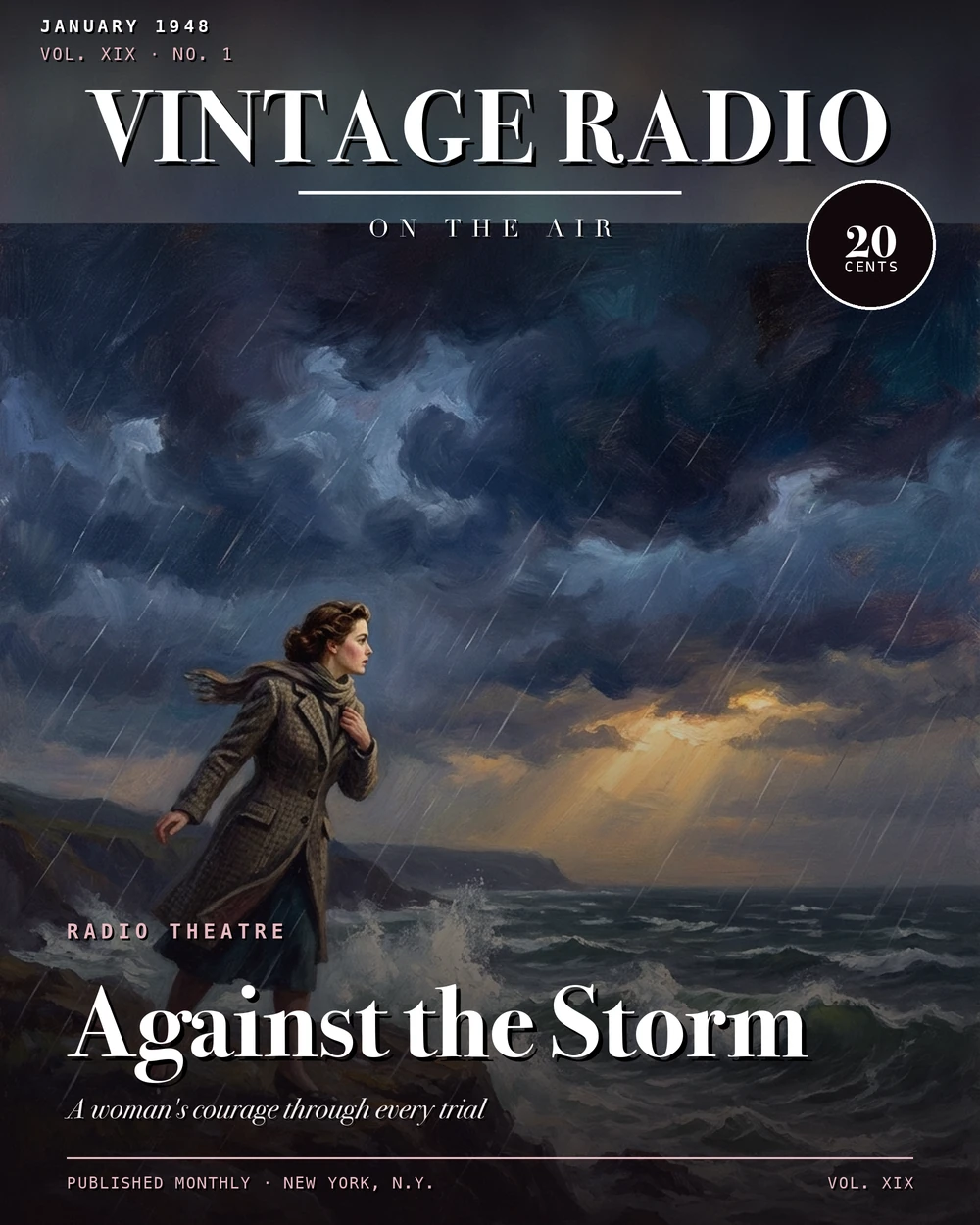
Against the Storm
The Show That Refused to Be a Soap Opera
Against the Storm holds a distinction no other daytime serial can claim: it is the only one ever to win a Peabody Award. That alone sets it apart. But the story of how a show airing between household-product commercials came to be recognized alongside the most prestigious radio drama of its day starts with its creator, Sandra Michael, and her genuine contempt for the genre she was working in.
Michael was born Anna Marie Mikkelsen in Denmark in 1906 and raised in Montana and Chicago. She attended the University of Illinois and the University of Chicago, and came to radio by an unlikely route — writing commercials, announcing fashion shows in Milwaukee, and hosting a program called The House Party on WGN. Before Against the Storm, she wrote Monticello Party Line, a syndicated 15-minute serial sponsored by a laxative brand. The contrast between that work and what she built next tells you everything about where her ambitions were pointing. She reportedly "saw red" when anyone called Against the Storm a soap opera, and she was explicit about why she made it: daytime radio, she believed, needed an antidote to the mindless formula of shows like Our Gal Sunday and Stella Dallas. She disdained the cliffhanger device that kept listeners hooked through manufactured suspense, and she wanted no part of it.
She began writing the first scripts on September 3, 1939 — the same day Great Britain declared war on Germany. That coincidence shaped everything that followed. By the time the show premiered on NBC's Red Network on October 16, 1939, with William Ramsey of Procter & Gamble having approved Michael's pitch, it already had a moral backbone that most daytime radio wouldn't touch.
What Happened on the Show
The central character was Professor Jason McKinley Allen, played throughout the series by Roger DeKoven. Allen taught at Harper University and lived at Deep Pool Farm — a setting drawn from the 32-acre Connecticut farm where Michael herself lived. He was a pacifist and an outspoken critic of Hitler, and the show established those positions early and held them. This wasn't a serial about misunderstandings and romantic entanglements resolved over weeks of breathless installments. It was about a man of conscience navigating a world at war, surrounded by a family whose lives intersected with that larger struggle.
The Allen family included his wife Margaret (played at various times by May Davenport Seymour, Katherine Anderson, and Florence Malone), daughters Christy (Gertrude Warner and Claudia Morgan) and Siri (Joan Tompkins and Dolores Gillen), and the people who moved in and out of their lives: Philip Cameron, who married Christy; Siri's husband Hal Thomas; and a surrounding cast that included Dr. Reimer, Nicole Scott, Mark Scott, and Kathy Reimer. Arnold Moss played Philip Cameron in the early NBC run before going on to a distinguished career in theatre, where he later played Prospero in Margaret Webster's 1945 Broadway production of The Tempest — the longest Broadway run of the play in history at 124 performances.
Some episodes had virtually no plot in any conventional sense. Entire broadcasts were given over to ballads, or to readings from Walt Whitman or Edna St. Vincent Millay. Edgar Lee Masters appeared on the show to read from his Spoon River Anthology. The poet John Masefield was short-waved in from Britain to deliver what was framed as a lecture to Professor Allen's class. A Memorial Day episode in 1941 was devoted entirely to a soliloquy about Allen's childhood friend Porky Mason, killed in France in World War I. For a moment, President Roosevelt was set to accept a speaking part, but that plan was shelved after Pearl Harbor.
How the Press Received It
The show attracted serious critical attention at a time when daytime radio rarely got any. A New York Times critic called it "stratospheric" compared to its neighbors on the afternoon schedule — which, on NBC, included The Guiding Light. Time magazine ran a piece headlined "Radio: Against the Claptrap" in November 1941. Variety, reviewing a 1941 episode about a girl refugee seeing the Manhattan skyline for the first time, called it "one of the most distinguished and stirring broadcasts in the history of commercial daytime radio."
James Thurber covered Against the Storm in his multi-part "Soapland" series in The New Yorker in 1948, eventually collected in his book The Beast in Me and Other Animals. Thurber wrote that its prose, "often sensitive, occasionally poetic, was a startling change from the general run of factory-made wordage." That's a precise description of what the show was doing. Radio historian Jim Harmon, writing in 1967, assessed Sandra Michael as "a writer who dealt in matters of stronger import, perhaps the only matters of any genuine import ever in a daytime soap opera," and contrasted her work favorably with the commercially dominant Elaine Carrington and the prolific Frank and Anne Hummert.
The Peabody Award — given for "Outstanding Entertainment in Drama" in the 1941 award cycle, the first year the Peabodys recognized individual programs — cited the show's "human interest and integrity" as "much needed." The official citation credited Sandra Michael alongside director John Gibbs, though most sources associate director-producer Axel Gruenberg with the show's day-to-day production. The title itself was a deliberate allusion: Against the Storm comes from King Lear, invoking the image of Lear raging at the elements.
Three Runs and a Recurring Fight
Against the Storm ran on NBC from October 1939 through December 25, 1942, sponsored by Procter & Gamble for both Ivory Snow Flakes and Ivory Bar Soap, with Ralph Edwards as announcer. Despite ratings described as respectable throughout, NBC's stated position when it ended was that the show "didn't click" with listening housewives — a characterization Newsweek reported at the time. Thurber later quoted the agency's version of events: that the plot had run its course in the first two years and that the serial had "deteriorated into a series of charming vignettes peopled by interesting and worthy personalities, with just no story line left."
Sandra Michael had a different account. She had asked the network to expand the show to a 30-minute daily format, which was unheard of for a soap opera at the time. When NBC refused, she requested and received her release from the agency. She eventually got the 30-minute format she wanted — but not until 1949, when the show returned on Mutual from April 25 to October 21 of that year, sponsored by Philip Morris. That run lasted less than six months.
The third and final run came on ABC from October 1, 1951, to June 27, 1952, again sponsored by Philip Morris, back to the original 15-minute daily format. Roger DeKoven returned as Professor Allen for all three runs, years apart — a sustained commitment to the character that gives the show an unusual continuity across a fragmented broadcast history. The 1949 Mutual run introduced Elliott Reid as Julian Browning and Eddie Mayehoff as Professor Waldo Greentree.
Roger DeKoven and the Cost of the Blacklist
DeKoven was born Roger Bennet DeKoven in Chicago in 1907, the son of Bernard DeKoven, a Russian-born Jew known for Zionist and charitable work. He attended John Marshall High School and later studied at the University of Chicago, Northwestern, and Columbia. In the mid-1930s, while directing a stock company, he directed the young Danny Kaye. He appeared in more than fifty old-time radio programs over the course of his career, including Suspense, Gangbusters, Grand Central Station, and Yours Truly, Johnny Dollar.
His career was interrupted in 1950 when his name appeared in Red Channels, the publication that listed suspected Communist sympathizers in broadcasting. He was blacklisted and unable to work until he signed a statement denying Communist affiliation, and he later publicly denounced his accusers. After Against the Storm he originated the role of Florenz Ziegfeld Jr. in the original Broadway production of Funny Girl, before being replaced by Alan Manson. He later held a recurring television role as Dr. Jim Spencer on Days of Our Lives and appeared in Oliver Stone's 1974 film Seizure and alongside Robin Williams in Seize the Day. He died of cancer at his Manhattan home on January 28, 1988.
What Survives
The show's theme music shifted over its run. An early version used "Ich Liebe Dich"; the more familiar theme was Alfred Newman's composition from Song of Bernadette. Eighteen episodes from the NBC run survive, with a combined running time of roughly four hours and twenty minutes, some of them in poor sound. No additional episodes beyond these eighteen are known to exist. The surviving titles — among them "Letter From Lucretia," "Memorial Day Memories," "Jason Remembers His Childhood," and "Supper in the Park" — give some sense of the show's texture: domestic, reflective, more concerned with inner life than with plot mechanics. For a soap opera that spent most of its run in a 15-minute daily slot, Against the Storm managed to leave behind something worth examining.